
Thursday, 27 September 2012
Thursday, 20 September 2012
FACEBOOK 101

Yesterday, this blog's Facebook page reached 101 likes! As you can see, 92 of them are friends of mine, most of whom were probably invited by yours truly. Still, I think this is fun. I joined Facebook in 2006, and I use it almost every day to connect with friends and co-workers, learning new things, and finding out about real-life events. In this way, the "social network"actually works almost like a well-connected city, with more or less rounded blocks of homes, stores, offices, restaurants and cultural scenes.

In this amazing map of Facebook friendships made by Paul Butler, you can see how large parts of the world are interconnected using this powerful network. I, for one, com from Norway, but have connections going to such far-off places as Kenya, Colombia, South Africa and Bangladesh. Read more about how the map was made in this short and interesting article.
Finally, a picture of a well-connected city, for comparison. Bologna in 1640:

May both the world and its cities become increasingly interconnected in the years to come!
Monday, 10 September 2012
THE BOATHOUSE

Earlier this summer, I was at the opening of a new cultural scene in Oslo, called Naustet, which means "The Boathouse". Inspired by traditional Norwegian boathouses and built directly above the water in the new waterside neighbourhood Bjørvika, this little gem was designed and built by students from Norway's three architecture schools, in the joint workshop called Trestykker.


"Tre" means both "three" (as in three architecture schools) and "wood" (as in made from) in Norwegian, and the whole thing is sponsored by different companies within the wood industry in Norway, including free materials.


The doors, back wall and wooden floors both inside and on the outside, are made from the excellent material Kebony, which has many of the same properties of tropical wood, but is made from local trees such as pine and maple, combined with leftovers from sugar factories.


The walls are clad in polycarbonate panels, which are partially opaque, depending if the sunshine is direct of filtered through clouds. Before sunset, the walls seem to be glowing.


The building stands in stark contrast to the other buildings of Bjørvika. While the rest are mostly glasshouses in a vulgar, petroleum-driven architectural language, who turn their back in the rest of the city, the Boathouse is a human-scale construction, made of wood, and talking to the city, actually turning its back on the water. In my opinion, this very last quality is also the best, and very brave, in a city that is forgetting what it has been for several hundred years. If the old Oslo, perched in the low, rolling hills, and the new Oslo down by the water are going to feel like one place instead of two, the communication has to go both ways.


The acoustic qualities of the building are excellent. There were three concerts during the opening, and I particularly enjoyed this one, by the wonderful Ingvild Våge. I also taped a video there, which I might post on the blog later.
The wood frames are made of plywood, which were pre-made, but glued and screwed together on site.


Let's hope that the Boathouse will find people to run it as a scene, and that Oslo will be inspired to create more architecture that relates to the site, is human in scale and materials, and dares to talk to the city. Good luck on next year's Trestykker!

Friday, 31 August 2012
FICTIONAL FRIDAY: OLYMPUS OF "IMMORTALS"

Fictional Friday is a series of posts on my blog, where I present fantastical and fictional architecture from books, television, films, computer games, art etc. every Friday.
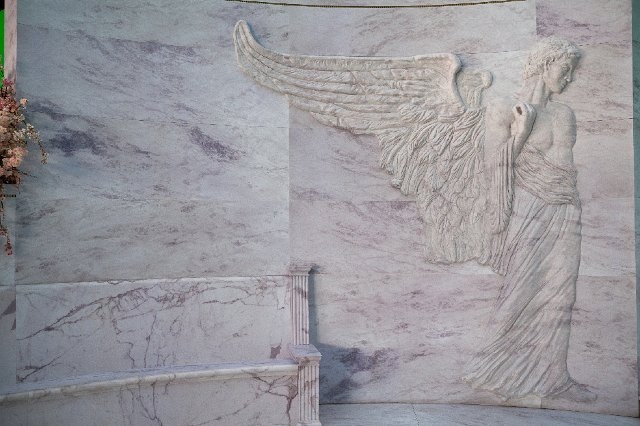
This week, something for those of you who just can't have enough of inventive Classicism: In the otherwise unimpressive film 'Immortals', there was a rather beautiful set, designed for Olympus, the home of the gods. Imagined as a synthesis of unpolished marble, symmetry and geometry, this amazing piece of fictional architecture reminded me of the stark and beautiful Nordic Classicism (sometimes referred to as 'Swedish Grace') of the 1920s. Have a look, ignore the silly costumes, pay notice to the nice Lucie Fournier relief and make up your own opinion:


Thursday, 30 August 2012
THE BEGINNING
Back in school. More than a year has passed and I really am a different person in more than one way. And ready.
The music is from the movie 'The Truman Show' from 1998, featuring some really cool sets, including the very real town of Seaside, a traditional-looking new town in Florida, and a place where I'd really like to go.
Wednesday, 29 August 2012
IAN BEGG AND THE SCOTTISH VERNACULAR

This is the Radisson BLU Hotel Edinburgh, on the famous Royal Mile in the middle of the city. It was designed by the Scottish architect Ian Begg, who has restored and built many beautiful buildings in Scotland. This hotel, which according to scottish-places.info filled anotorious gap site, was completed in 1990! It's a very traditional building, designed in a sort of local vernacular style, but it's not made to look old by applying fake ageing techniques or anything of the sort.

On the side of the main entrance, there is a plaque, inscribed with the words "AL THIS WARK WAS BEGUN DANCON ON 10-JANUARY-1989 AN ENDIT BE THEM ON 31-MARCH-1990", leaving no doubt as to the building's age. There's another plaque at the foot of the tower (covered up in the top picture, but normally visible), clearly stating the year the hotel was built "AD 1989". I did not get to see much of the interiors, but I did pay a visit to their elegant lobby, in which I found friendly staff, who unfortunately were not able to tell me the name of the architect. In my opinion, they should be informing their guests about this very special building and the architect behind it.

Ian Begg has a passion for everything Scottish, and is the architect behind many new buildings in this and related styles. On his excellent website you can read more about his work, and even see an excerpt from a series of BBC programmes on "The Scottish House" from the early 1970s (which, by the way, should be published online, on Youtube or elsewhere). An excerpt:
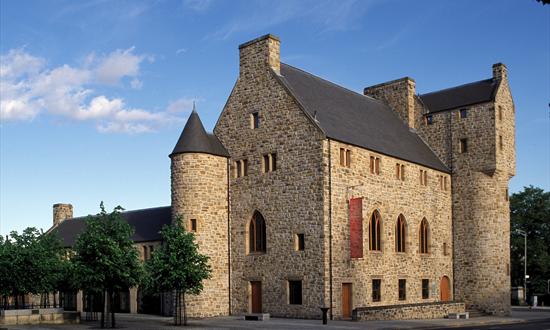
This very sincere and talented man is also the architect of another beautiful urban Scottish building, St. Mungo Museum of Religious Life and Art, in Glasgow.
 |
| Photo courtesy of visitscotland.com |
Constructed in 1993, the building blends in with its surroundings while still retaining a character of its own. The design is intended to reflect the now lost medieval Glasgow Castle, which formerly occupied the site, but sadly was torn down at the end of the eighteenth century. Apart from exhibitions on religious life in Scotland, the building also features a Zen garden, a courtyard used for markets, festivals concerts, as well as stain More pictures of the exteriors, interiors and even a model of the building can seen at Undiscovered Scotland.

 |
| Zen garden |
 | |
|
 |
| The courtyard during Merchant City Festival |
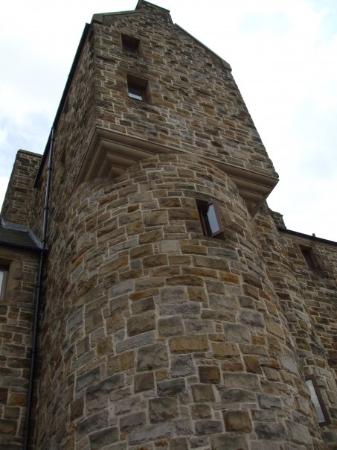
This photo of St. Mungo Museum of Religious Life and Art is courtesy of TripAdvisor
Discovering the work of Mr Begg has certainly motivated me to make more trips to Scotland, and learn more about this interesting designer and his thoughts on architecture. Wish me luck!
Thursday, 16 August 2012
THE FUTURE ACCORDING TO TOR
Made by a friend of mine, I like how this video suggests that things are going in the right direction, and architects may have a role in finding the way.
Friday, 27 July 2012
KATY PERRY AND THE AESTHETICS OF SURREAL FANTASY
Yes, it's kitschy. Yes, it looks rather fake. But it's also imaginative and kinda cool.
Fictional Friday is a series of posts on my blog, where I present fantastical and fictional architecture from books, television, films, computer games, art etc. every Friday.
No comments:
 Labels:
Colour,
Complexity,
Fictional Friday,
Films,
Gardening,
Imaginary places,
Landscape,
Music,
Ornaments,
Sampling,
Scenic design,
Silliness,
Stone
Labels:
Colour,
Complexity,
Fictional Friday,
Films,
Gardening,
Imaginary places,
Landscape,
Music,
Ornaments,
Sampling,
Scenic design,
Silliness,
Stone
Labels:
Colour,
Complexity,
Fictional Friday,
Films,
Gardening,
Imaginary places,
Landscape,
Music,
Ornaments,
Sampling,
Scenic design,
Silliness,
Stone
Monday, 23 July 2012
THE ERECHTEION

Today, I started reading about the Erechteion of Athens (ca. 405 BC), after being reminded of the existence of this strange and wonderful building just a few days ago.

Although mostly known for its caryatids, this structure in my opinion deserves just as much attention for it complex and non-symmetrical approach to the architectural language it works within, what we now call classicism.

After some quick googling, I found out that an amazing new digital reconstruction project is going on, which already has a very interesting website, where I stole these pictures (Thanks, guys!), and will be featured in a future documentary. The website has several trailers, pilots and 3D animations, which for some strange reason have not been published on neither Youtube nor Vimeo, but are very interesting and worth looking at nonetheless.

I'm looking forward to learning more about this interesting and, according to the people in it, potentially revolutionary project.

Sunday, 22 July 2012
THE UNIVERSE AS SEEN FROM UTØYA ISLAND

If you look long enough, you'll see how the trees spell out the word 'love'.
Thursday, 19 July 2012
PINE HORIZON

You might have heard of the pines of Rome, but what about the pines of Skjeberg?
As some old readers may have noticed, I'm very much concerned with how the architecture we create, meets the sky. In nature, the horizon is never boring, but in architecture, it often is. So maybe, the next time you're out there shaping a part of your fellow citizens' horizon, in the shape of a roofline, a garden or a tree-lined street, and you think it looks too simple, maybe you should consider using a pine? They grow into all kinds of shapes and sizes, smell nice, and produce cones than are fun to play with.
As for the picture, it looked better the way it was taken, a bit tilted, and depicts me and my friend Freja-Lina in between all the pines.
Friday, 13 July 2012
THE FANTASTIC FLYING BOOKS OF MR. LESSMORE
Watch this amazing short film about a man and the books he meets. The quality on Vimeo is ok, but I recommend downloading it cheaply at http://morrislessmore.com/. Have yourself a very Fictional Friday!
(Fictional Friday is a series of posts on my blog, where I present fantastical and fictional architecture from books, television, films, computer games, art etc. every Friday.)
("Less is more" - Ludwig Mies van der Rohe)
("Less is a bore" - Robert Venturi)
Subscribe to:
Comments (Atom)


