Showing posts with label Sampling. Show all posts

Tuesday, 20 January 2015

THE UNITED STATES OF IN-YOUR-FACE

Pavillion of the USA, World's fair 1900, Paris


Not exactly my definition of beauty, but it sure makes a statement. 1900 must have been a strange time to be alive.

Saturday, 11 October 2014

ESCHERESQUE WORKMEN


(M. C. Escher, Dutch graphic artist with a taste for illusions and paradoxical constructions drawn in 2D.)

(Robert Leighton, cartoonist. A short article on how this one was created can be found here.)

Friday, 26 September 2014

FICTIONAL FRIDAY: TRIGAN CITY

From left: King, Architect, Other Guy. Credits: Probably Don Lawrence


While looking for a desk chair at a flea market last Sunday, I stumbled upon a comic book which I'd never heard of before. However, it contained pictures of fantastic cities, dams blowing up and futuristic technologies mixed with ancient and diverse artistic references, so I paid a few kroner for it, and brought it home.

Turns out, this was the first story of the infamous(/famous?) sci-fi/historical fantasy comic book series called The Rise and Fall of the Trigan Empire, which enjoyed a long life considering its genre, continuously published between 1966 and 1982. There's actually a rather large focus on architecture and cities in the series, and the architect Peric is one of its main characters. The imaginations of writer Mike Butterworth and artist Don Lawrence should probably share the credits for the interesting concepts.

The Trigan City is, like many other visual elements of the series, a fantasy on Ancient Roman features. White stone, columns (columns, columns), pediments and round arches are recognisable parts of Roman classicism, whereas onion domes, spires and other features of medieval architecture pierce the horizon and prevent monotony.

Friday, 12 September 2014

FICTIONAL FRIDAY: RIGEL VII


So, thanks to Netflix I've started  watching the original Star Trek-series, here represented by the Orient-inspired (Jerusalem meets Lhasa) Riegel VII. I'm rather amazed, but as George Takei (who by the way was very hot back then) would say: Oh myyy!

Friday, 29 August 2014

FICTIONAL FRIDAY: SIDONIA


Long after the destruction of our Solar System, the space station city state of Sidonia may be the last remnant of mankind. In the newish Netflix series Knights of Sidonia, we observe what happens when an outsider from the deep and mysterious foundations of the city enters the world above, and goes further into space to fight the monsters that threaten the city's existence.


The city of Sidonia is a curious place. Unlike so many other visions of the future, a certain degree of organised complexity seems to the the principle with which it has been formed. The steel and glass skyscrapers which are at the core so many visions of the future are very absent, and in their place, we find an amazing diversity.

Artificial landscapes, bodies of water and immense structural skeletons of metal actually seem to be complemented by masonry buildings, with facades reminiscent of fortified European architecture, modern Japanese structures and weightless Middle Eastern villages stacked on top of each other. 


Hipped roof with terracotta tiles and what looks like green copper cladding, external staircases, courtyards, cloisters and even streetscapes give these conglomerates a wonderful amount of variation. Especially interesting is the way it all seems to have grown over time, with additions, nooks, balconies, bridges and towers. However, it all comes together as a rather harmonious-looking built environment, forming an effective background for the dramatic actions of the series. I'm fascinated.


PS. If you'd like to check out some real world-attempts at the same thing, check out the work of Ricardo Bofill, or MVRDV's Vertical Village concept.

Wednesday, 19 February 2014

HURVA AND THE POWER OF RECONSTRUCTION

Main facade


Earlier today, my friend Anita sent me an article about the Hurva Synagogue in Jerusalem. Dating back centuries, it was reconstructed and re-opened in 2010, after having lain in ruins since 1948.

Actually, the building has been torn down several times, thus earning its name, which means "ruin" in Hebrew. However, it's also been rebuilt, time and time again, not at least because of its importance as a symbol for Jewish presence in Jerusalem and Palestine throughout the ages.

This also meant that the reconstruction was seen as a provocation by parts of the Arab population, who protested the re-opening, claiming that it was the start of a campaign to conquer Jerusalem on behalf of the Jewish people, eventually leading to Israel destroying landmarks of Arab presence in the city.

For others, however, the reconstruction meant recovering a missing piece of the puzzle that is Jewish history. The old synagogue was a symbol of Jerusalem itself, and many later synagogues around the world were modelled on its neo-byzantine design. Getting it back, meant that a memory once again became reality.

This blog is mainly about architecture, not politics, but it's interesting to see how the erection of a building has very different meanings, depending on who you're asking. The Hurva Synagogue is also a prime example of how important historical buildings and cities are to our identities, even when they are (almost) completely rebuilt.


The ruin, 1967


Interior of the building, clearly showing where parts
of the old ruin were incorporated in the new structure.


All pictures: Wikimedia Commons

Tuesday, 11 February 2014

PHYSALIS

Picture by Wikimedia Commons


Eating delicious Phsyalis berries as an evening snack, I'm thinking it would be great to make a building with a structure based on that of a of a Physalis shell. A greenhouse, perhaps?

Friday, 10 January 2014

FICTIONAL FRIDAY: FROZEN or WHY NOT LIVE IN A STAVE CHURCH?


I watched this wonderful little film in Christmas, and was blown away by all the wonderful design. Disney was heavily inspired by the Norwegian landscape, especially Western Norway, and went on several study trips to establish the asthetics of Arendelle, the kingdom in which the film takes place.

Apart from nice music and charming characters, I guarantee you'll love the buildings, which were copied from famous Norwegian buildings and building types, such as Akershus fortress in Oslo, Bergen city centre, stave churches and log-built houses. The royal palace is basically a stave church with bedrooms.

Poster


Hello, Arendelle


Hello, Gol Stave Church


Hello, Akershus Fortress


Hello, Bergen


Oh, and the queen builds a pink and blue ice palace at one point.

Friday, 15 November 2013

FICTIONAL FRIDAY: DUSSO'S THEED


This amazing image is the work of Yanick Dusseault, and depicts the city Theed of the planet Naboo in the Star Wars universe. Naboo is known for its combination of advanced techonology with classicish (my word) architecture.

The focus is on Theed's large royal palace, which supposedly had another tower added by each new monarch, to show his or hers... er... capability. Or something. Looks bloody beautiful, anyway.

Friday, 8 November 2013

FICTIONAL FRIDAY: THE THIRD AND THE SEVENTH


The Third & The Seventh from Alex Roman on Vimeo.

Please watch this beautiful little film of architecture real, imagined and re-imagined (in fullscreen); it's a nice reminder of how architecture sometimes can be an art.

One of the most important buildings featured in the film is Louis Kahn's Exeter library. The more I learn about Kahn, the more I come to love his work. There's a rather huge Kahn exhibition at the Oslo Museum of Architecture right now. Anyone who hasn't seen it, really should go. Last day of the exhibition is 26th January 2014.

Finally, thanks to Joan, who made me aware of the film a long time ago. I love it.

PS. TOEFL test tomorrow, needed for my applications to the schools I want to get in to in the US. Wish me luck!

Friday, 19 July 2013

FICTIONAL FRIDAY: GWEN'S CARROLLESQUE GARDEN


One of the coolest gardens I know, quite clearly inspired by Lewis Carlloll's Alice in Wonderland, a book which I was very fascinated and confused by in my childhood, and still love.

Wednesday, 17 July 2013

CLASSICAL SUBSTATION BUILDING


Walking around my home town today, I just had to take a picture of this wonderful little structure. Architect and year is unknown, but I would guess it's from around 1920, and probably not yellow originally.

There doesn't seem to exist any kind of building which can't be executed in a classical manner, does it?


Monday, 11 February 2013

JIM KAZANJIAN AND THE ARCHITECTURE OF THE SURREALLY POSSIBLE

The works of artist Jim Kazanjian, these amazing pictures are compiled from images of buildings found online. Although dreamlike and amazing, what I like the most about them, is that the majority of these structures actually could be built. I truly wish contemporary architecture was more like this.


Friday, 2 November 2012

FICTIONAL FRIDAY: PUSHWAGNER'S SOFT CITY


In the early 1970s, the Norwegian artist Hariton Pushwagner created a dystopian vision of the modern city, with cars, monotony and soulless architecture, called Soft City. In this amazing series of drawings, he showed a day in this horrible society where identity is history, variation is fault and likeness the prime virtue. In many ways, this was probably nor only a reflection of Pushwagner's political views, but just as much a reaction to how Norwegian architecture was developing at the time.


One example can be found in Fantoft student hostel in Bergen, where repetition, uniformity, lack og scale and boring and ugle materials are combined with boring setting to create something that could easily have inspired Pushwagner.


The artist kept returning to Soft City, and not all of these drawing come from the original series. A book with the first edition of Soft city was published some years ago. I own a copy, but I'm not sure if it can be bought online. The ISBN number is 9788291187785, and the book is very much recommended.


Finally, a short film version of Soft City:

Friday, 31 August 2012

FICTIONAL FRIDAY: OLYMPUS OF "IMMORTALS"


Fictional Friday is a series of posts on my blog, where I present fantastical and fictional architecture from books, television, films, computer games, art etc. every Friday.

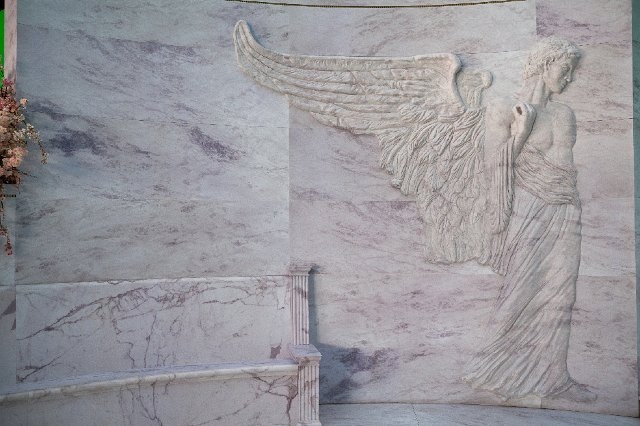
This week, something for those of you who just can't have enough of inventive Classicism: In the otherwise unimpressive film 'Immortals', there was a rather beautiful set, designed for Olympus, the home of the gods. Imagined as a synthesis of unpolished marble, symmetry and geometry, this amazing piece of fictional architecture reminded me of the stark and beautiful Nordic Classicism (sometimes referred to as 'Swedish Grace') of the 1920s. Have a look, ignore the silly costumes, pay notice to the nice Lucie Fournier relief and make up your own opinion:


Related Posts Plugin for WordPress, Blogger...